Zahran Marble Zahran Marble

2026 Best Italian Marble How to Spot Imitations?

Time:2026-10-19 Author:Ethan
0%

In 2026, Italian marble remains associated with refined architecture, heritage quarries, and long-term performance. Yet appearance alone proves very little. Printed porcelain, resin composites, and lower-grade stone can imitate Calacatta, Carrara, or Statuario patterns convincingly. The real question is not simply How to identify high-quality Italian marble vs imitations. It is how to verify mineral identity, origin, processing quality, and documented performance.

Industry evidence supports a careful approach. Confindustria Marmomacchine’s recent Italian stone-sector reports continue to emphasize Italy’s strength in processing technology, finished products, and international exports. However, export origin does not automatically prove quarry origin. Italy may process stone extracted elsewhere. The USGS Mineral Commodity Summaries, including its dimension-stone coverage, also warns that global production statistics remain incomplete and difficult to compare. That limitation matters when suppliers present impressive numbers without traceable documentation.

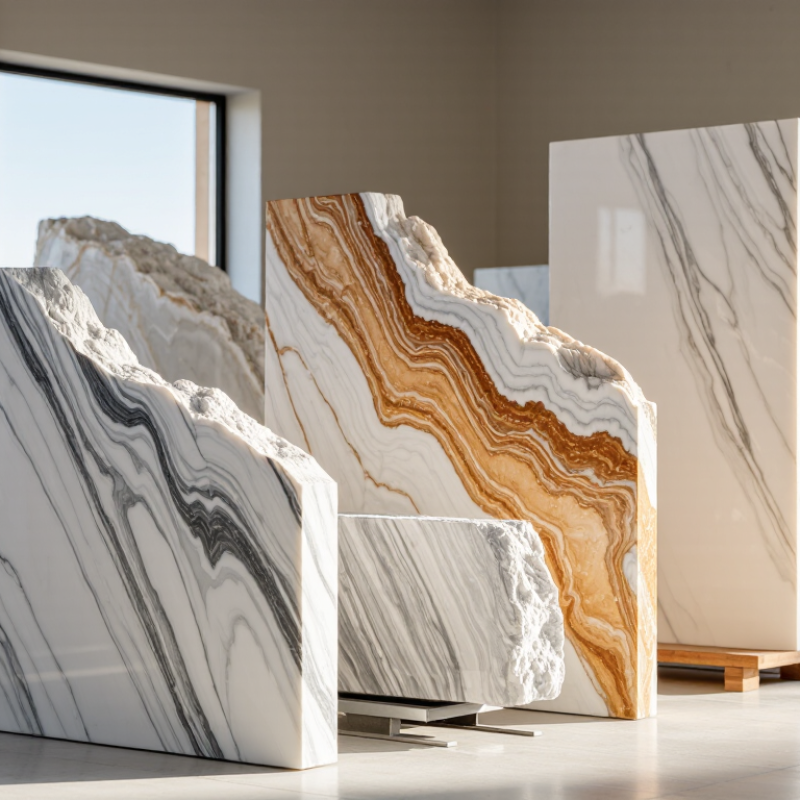
Look closely at the slab edge. Natural marble usually shows mineral movement through its thickness, while a printed surface may reveal a repeated image or abrupt pattern change. Veins should not look perfectly duplicated. They may contain tiny crystals, soft transitions, and occasional irregularities. Request petrographic identification under EN 12407 and water-absorption testing under EN 13755 when the project carries serious cost or safety consequences. Ask for the quarry name, batch details, test results, and commercial invoice. A QR code alone is not evidence.

No checklist is infallible. Even experienced buyers can misjudge polished stone under showroom lighting. A wet sample may also exaggerate color depth. Independent laboratory confirmation remains the stronger safeguard. This guide examines practical inspection steps, credible documents, and warning signs before payment, installation, or public specification.
2026 Best Italian Marble How to Spot Imitations?

What Defines Genuine Italian Marble in 2026

Genuine Italian marble is defined by geology, quarry provenance, and tested performance—not by a white background alone.

Marble forms from recrystallized limestone, so its crystals, veining, and mineral inclusions vary naturally. A perfect repeated pattern may indicate a printed or engineered imitation. Real stone usually shows irregular veins continuing through the slab edge.

Look closely.

Documentation matters. Istat’s 2024 foreign-trade tables classify Italian stone by customs codes, but those codes do not prove quarry origin. Request a quarry statement, extraction location, batch number, and processing records.

Then compare them with the supplier’s technical sheet. According to EN 13755, water absorption testing helps assess porosity, while EN 1936 measures apparent density and open porosity. These results should match the proposed marble’s technical identity.

A practical check uses a hidden edge. The pattern should not stop at the polished surface. A weak acid test can damage calcareous stone, so professional laboratories should handle it.

Avoid relying on color alone. Genuine marble may contain tiny fossils, hairline mineral seams, or uneven crystals. That is not automatically a defect.

I have seen buyers reject authentic slabs because they expected showroom uniformity. That judgment needs reconsideration.

The European Commission’s 2024 construction-product guidance also emphasizes traceable technical documentation and performance evidence, not visual claims.

Ask for test dates, laboratory identification, and the exact material name. Vague wording deserves caution.

How to Verify Marble Origin and Supplier Documentation

2026 Best Italian Marble: How to Spot Imitations?

Authentic Italian marble should have a traceable origin, not only an attractive surface. Ask the supplier for the quarry name, extraction region, block number, and shipment records. These details should match across the quotation, invoice, packing list, and certificate of origin. Check the stone’s veining in natural light. Real marble usually shows depth, small mineral changes, and irregular movement. A printed pattern often looks too flat or repeats across several slabs.

A reliable supplier should provide recent laboratory reports for water absorption, density, flexural strength, and surface durability. These documents help confirm the material’s performance, but they do not prove Italian origin alone. Request high-resolution photos of the actual slabs, including markings on the crate or rear surface. Compare those markings with the block identification in the documentation. I have seen beautiful samples differ from delivered slabs. That mistake is costly and avoidable.

Tips: Verify documents with the issuing authority when possible. Ask for a small physical sample before approving a large order. Keep every record together. Do not trust vague phrases such as “Italian style” or “European quality.” If a supplier avoids clear answers, pause the purchase. Documentation may contain errors, and even careful buyers can miss them. A second inspection is sometimes worth the delay.

How to Examine Veining, Texture, Color, and Surface Quality

2026 Best Italian Marble: How to Spot Imitations?

Italian marble should be examined under daylight, not showroom spotlights. Natural veining usually changes direction, thickness, and density across the slab. Repeated diagonal patterns may suggest printed material or engineered stone. Still, uniform veins do not prove imitation. Some genuine blocks produce remarkably consistent surfaces.

Run your fingers across the finish. Polished marble feels glassy, while honed marble feels softly matte. Artificial surfaces can feel too uniform, especially along cut edges. Check the edge for tiny mineral crystals and irregular color transitions. A plastic-like edge deserves caution. Look for hairline resin filling, which can be acceptable, but should be disclosed.

Color must be judged beside a neutral white card. Warm gray, cream, or cool white may shift under artificial lighting. Place a small water drop on an unsealed sample and observe it for several minutes. Darkening can indicate absorption, but sealing changes the result. Do not treat this test as proof.

According to the U.S. Geological Survey’s Mineral Commodity Summaries 2025, dimension stone remains an internationally traded mineral category, making documented origin and material testing important. Grand View Research estimated the global natural stone market at about 51.6 billion dollars in 2023, with continued growth projected through 2030. The numbers explain why imitation products are increasingly convincing. ASTM C170 and C880 testing can verify strength, but neither test alone confirms Italian origin. My own inspection rule is simple: trust several small clues, not one dramatic vein. Labs remain necessary when the purchase value is high.

2026 Best Italian Marble: How to Spot Imitations?

A practical comparison of veining, texture, color, translucency, and surface quality

Inspection Dimension Typical Natural Italian Marble Common Imitation Indicators How to Examine It Reliability
Veining Pattern Veins usually vary in width, direction, density, and intensity. Natural fissures may branch or fade gradually. Repeated lines, identical patterns across several pieces, sharp printed edges, or veins that stop unnaturally at the edge. View the slab from different angles and compare multiple pieces from the same lot. Check whether the pattern continues naturally through the thickness. High for printed surfaces; medium for engineered stone.
Vein Depth Mineral veins are part of the stone and may remain visible on a freshly cut edge or honed surface. A decorative image may appear only on the top layer, while the edge shows a plain ceramic, resin, or uniform composite body. Inspect an exposed edge, cut-out, or sample cross-section. Do not damage an installed surface without permission. High when an edge is available.
Surface Texture Polished marble feels smooth but retains subtle mineral variation. Honed marble has a soft, low-reflective feel rather than a plastic-like film. A perfectly uniform coating, synthetic slickness, visible film, or a texture that does not correspond with the visual pattern. Run clean fingertips over the surface and use low-angle light to reveal coating marks, orange-peel texture, or uneven finishing. Medium; finishing methods can alter feel.
Color Variation Natural slabs commonly show gradual shifts in white, cream, gray, beige, or other mineral tones. Small tonal differences are expected. Unnaturally uniform color, harsh digital-looking contrast, or the same shade and pattern repeated across every tile. Compare the sample under daylight and warm indoor lighting. Check several areas rather than judging one small corner. Medium; some natural stones are visually uniform.
Translucency Some light-colored marble can transmit a small amount of light, especially near thin edges or around translucent mineral areas. No light transmission in a thin, light-colored piece, or an evenly glowing surface that suggests a printed or resin-based layer. Place a small LED light behind an uninstalled sample in a dark area. Compare the result across different parts of the stone. Low to medium; thickness and stone type matter.
Surface Reflection A quality polish produces clear reflection with natural variation caused by mineral grains, micro-pits, and the finishing process. Excessively mirror-like reflection, waviness, cloudy patches, or a reflective top layer that looks separate from the body. Reflect a straight object, such as a ruler, across the slab. Distortion may indicate uneven polishing, although it is not proof of imitation. Medium; poor finishing can affect natural stone.
Edge Appearance The edge generally shows the same mineral body as the face, with veins or color variation continuing into the section. A separate backing, uniform white or gray core, decorative film, or a very different material beneath the surface. Examine a polished edge, sink cut-out, or factory sample. Look for a printed layer, backing mesh, or abrupt color transition. High when the edge is exposed.
Water Absorption Marble is a porous natural stone; absorption varies by mineral composition, formation, finish, and sealer. A darkened spot may appear after water contact. Some nonporous imitations show little or no visible change, while other imitations may absorb water unpredictably. On an approved unsealed offcut, place a few drops of water for approximately 10–15 minutes and observe darkening. Dry and reseal if appropriate. Low alone; sealers and finishes affect results.
Scratch Resistance Marble is mainly composed of calcite and is relatively soft compared with quartz and many ceramic surfaces; it can scratch from harder materials. A surface that resists ordinary metal or abrasive contact may be a harder ceramic, porcelain, or engineered material rather than marble. Do not scratch an installed or valuable slab. If testing an offcut, use a controlled professional mineral-hardness test instead of a household knife. Medium; destructive tests are not recommended.
Acid Sensitivity Calcite-based marble can etch when exposed to acidic substances such as lemon juice, vinegar, and some cleaning products. A surface that shows no reaction may be non-calcite material, but coatings and sealers can also mask the result. Avoid acid testing on finished or installed material. A stone laboratory can identify mineral composition safely and accurately. Medium; professional testing preferred.
Weight and Thickness A natural stone slab has a consistent stone body and substantial weight for its thickness. Typical architectural slabs are commonly around 20–30 mm thick, but dimensions vary. Unexpectedly light panels, hollow sounds, layered construction, or a thin decorative sheet mounted on a different substrate. Confirm thickness with calipers and compare weight only with samples of equal size. Construction methods can change total weight. Low to medium; format affects weight.
Best Verification Method Documentation should identify the material as natural stone and provide quarry, origin, thickness, finish, and batch information where available. Vague descriptions such as “marble look,” missing technical details, inconsistent specifications, or refusal to provide a sample or test report. Request a labeled sample, inspect an edge, review the technical datasheet, and use an independent stone laboratory for high-value purchases. Very high when independently verified.
Practical conclusion: No single visual test proves origin or authenticity. For the most dependable assessment, combine edge inspection, natural pattern analysis, surface examination, technical documentation, and independent laboratory identification.

How to Detect Common Imitations and Manufacturing Tricks

2026 Best Italian Marble: How to Spot Imitations?

Italian marble is judged by geology, not only appearance. The U.S. Geological Survey’s 2025 Mineral Commodity Summaries tracks dimension stone as a separate construction material category. That distinction matters. Engineered surfaces may mimic marble, but they lack natural mineral variation.

Inspect the slab under strong side lighting. Genuine marble usually shows irregular veining, small crystal changes, and slight color movement. Printed imitations often repeat patterns across adjoining pieces. Look at the edge, too. A natural slab carries its veining through the thickness, while printed surfaces may show a uniform backing. Some fabricators also apply resin fillers, color enhancers, or glossy coatings to hide pores and weak areas. A wet cloth can reveal uneven absorption.

Check the supplier’s technical documents. Request the quarry location, block or slab identification, petrographic description, water absorption, and flexural strength. ASTM C615 testing helps evaluate marble used in construction. The Natural Stone Institute also recommends reviewing test results rather than trusting visual claims. Be careful with unusually perfect surfaces. Real stone is rarely perfect.

One mistake is assuming every dark vein proves authenticity. It does not. Some resins imitate dramatic veining convincingly. I would also inspect several slabs from the same lot, because one sample can mislead. When records are incomplete, treat the material as unverified, not Italian marble.

How to Confirm Authenticity Through Testing and Expert Inspection

Imitation marble can look convincing under showroom lights. Confirming authenticity requires more than matching color and veining. The 2023 Grand View Research report valued the global natural stone market at about USD 51.5 billion in 2022, showing why misrepresentation remains a practical purchasing risk.

Ask for a cut sample from the supplied slab, not a loose promotional piece. A qualified laboratory can measure water absorption and bulk density under ASTM C97 procedures. Genuine marble usually shows mineral variation, microscopic calcite crystals, and natural pores. Petrographic microscopy can reveal these features. Raman or infrared analysis may also identify resin-rich surfaces and non-stone fillers.

Use a low-risk inspection plan. Examine the polished edge for a printed layer, repeated veining, or a sharp transition between surface and core. A thermal response test can expose resin panels, but uncontrolled heat may damage the finish. Acid testing is also risky and should be performed only by trained professionals. Do not rely on one result.

An independent petrographer should compare the slab, quarry documentation, and test findings. Experts can distinguish marble from engineered stone, limestone, or coated ceramic materials. However, laboratory testing cannot always prove quarry origin. I have seen samples pass basic density checks yet fail microscopic review. That is why chain-of-custody records, sealed samples, and written inspection reports matter. Verify before fabrication.

FAQS

Why should marble be inspected in daylight?

Daylight reveals true color and surface variation more accurately than bright showroom spotlights. Artificial light can hide subtle defects.

What veining patterns may suggest an imitation?

Repeated diagonal veins across nearby slabs may indicate printed material or engineered stone. Still, regular veining does not prove imitation.

How can touch help identify marble?

Polished marble feels glassy, while honed marble feels softly matte. An overly uniform surface deserves closer inspection.

What should I inspect along the slab edge?

Look for tiny mineral crystals, uneven color transitions, and veins continuing through the thickness. A plastic-like edge is concerning.

Can water absorption testing confirm genuine marble?

Place one water drop on an unsealed sample and watch for several minutes. Darkening may indicate absorption, but sealing can change the result. It is not proof.

Which documents should a supplier provide?

Request the quarry location, slab identification, technical description, absorption results, and flexural strength data. Incomplete records mean the material remains unverified.

Why is one visual clue not enough?

Dark veins, perfect color, or unusual brightness can be created with resin and coatings. Several small clues provide stronger evidence. One dramatic vein can mislead.

When should an independent laboratory inspect the marble?

Use laboratory testing when the purchase value is high or documents seem incomplete. Microscopy can examine mineral crystals, pores, fillers, and surface coatings. Testing has limits.

What sample should be tested?

Submit a cut sample from the supplied slab, not a loose promotional sample. Keep it sealed and document its chain of custody.

Can testing prove the marble came from a specific quarry?

Testing can distinguish natural marble from engineered stone, ceramic, or coated materials. It may not prove exact quarry origin. That distinction matters.

Conclusion

This guide explains how to identify high-quality Italian marble vs imitations by focusing on origin, documentation, appearance, and performance. Genuine Italian marble should be supported by clear supplier records, quarry information, product specifications, and consistent traceability. Buyers should carefully examine the stone’s veining, color variation, texture, translucency, edge details, and surface finish, as natural patterns usually show subtle depth and irregularity rather than repetitive designs.

The article also discusses common imitation techniques, including printed patterns, artificial aging, resin filling, excessive polishing, and engineered materials made to resemble natural stone. To confirm authenticity, buyers can request samples, compare multiple slabs, inspect cut edges, and arrange professional testing or evaluation by an experienced stone specialist. Combining visual inspection with reliable documentation and expert advice can help identify genuine marble, avoid misleading presentation, and select a durable material with authentic character.

Ethan

Ethan

Ethan is a seasoned marketing professional with a deep expertise in our company's innovative product line. With a passion for sharing knowledge and insights, he takes the lead in regularly updating our corporate blog, where he explores industry trends, product features, and effective marketing......