Zahran Marble Zahran Marble

What Are the Pros and Cons of Honed vs Polished Marble?

Time:2026-10-04 Author:Sienna
0%

What Are the Pros and Cons of Honed vs Polished Marble? This question matters when choosing marble for floors, countertops, bathrooms, or fireplace surrounds. The finish changes more than appearance. It affects traction, maintenance, stain visibility, and how the stone feels beneath your hand.

Stone-care expert Fred Hueston offers a practical principle: “The best stone surface is the one that matches the way people actually live.” A polished finish reflects light and highlights marble’s veining. It can make a small kitchen appear brighter and more spacious. However, polished marble may show scratches, etching, water spots, and fingerprints quickly. Spilled lemon juice can leave a dull mark within minutes.

Honed marble has a soft, matte surface with less reflection. It often feels calmer and more natural. Small scratches may be less noticeable, especially in busy hallways or family kitchens. Its lower sheen can also provide better visual grip, although it is not automatically slip-proof. The trade-off is real. Honed stone may absorb stains more readily because its surface remains more open. Dark liquids, cooking oil, and muddy shoes require quick attention.

Neither finish is universally better. That is easy to forget. A polished bathroom vanity may suit careful daily use, while honed flooring can feel safer and more forgiving. Yet household habits, stone type, sealing quality, lighting, and professional installation all influence the result. This guide examines the advantages and limitations of each finish, helping readers choose marble with clearer expectations rather than showroom excitement alone.
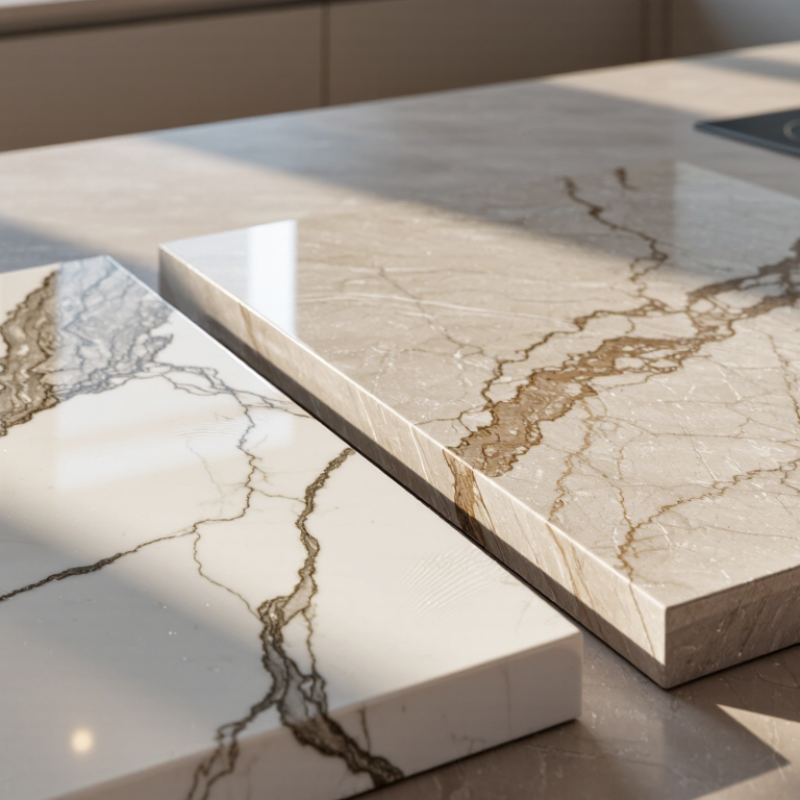
What Are the Pros and Cons of Honed vs Polished Marble?

Honed vs Polished Marble: Definitions, Texture, and Light Reflection

Honed and polished marble differ mainly in surface treatment, texture, and light reflection. Honed marble is mechanically smoothed but left without a glossy finish. Its surface feels soft, velvety, and slightly matte under the hand. Polished marble receives additional abrasive treatment, creating a reflective surface that feels slick and refined. The stone itself remains the same, but the finish changes its visual character.

Honed marble absorbs light instead of bouncing it sharply across a room. Veining often looks quieter, warmer, and more natural. This finish can hide small scratches and minor etching better than polished marble. However, it may absorb spills more readily if the stone is not sealed properly. It can also appear less dramatic in rooms with limited daylight.

Polished marble reflects windows, lamps, and ceiling lights like a calm sheet of water. Its colors usually appear deeper, and its veining becomes more noticeable. This quality suits formal walls, counters, and decorative surfaces. The drawback is practical. Fingerprints, water spots, and acidic marks can stand out quickly. Wet polished marble may also feel slippery underfoot.

During material selection, I compare a sample under both daylight and warm indoor lighting. A finish that looks perfect in a showroom can feel too harsh at home. I once preferred a high-gloss sample, then noticed every nearby reflection after installation. That changed my judgment. Texture matters as much as appearance.

Material Baseline: Marble’s Mohs Hardness of 3–5 and Natural Porosity

Marble sits around 3–5 on the Mohs hardness scale, so it scratches more easily than many homeowners expect. A steel utensil, gritty plate, or sand trapped under a vase can mark the surface. Polished marble reflects light and reveals veining dramatically. Its smooth surface also feels easier to wipe after spills. However, scratches and dull patches can become obvious near busy counters.

Honed marble has a soft, matte appearance that suits floors, bathrooms, and relaxed interiors. Small scratches often disappear into its low-sheen texture. The trade-off is a greater risk of visible darkening from oil, coffee, or colored soap. Natural marble contains microscopic pores, and polishing does not remove them. It can reduce surface absorption, but it cannot make the stone completely nonporous.

I learned this the hard way.

A sealed sample may resist a splash, while an unsealed edge absorbs it quickly. Testing a spare tile with water and cooking oil gives more useful evidence than relying on appearance alone. Use coasters, wipe acidic liquids promptly, and place protective pads beneath ceramic objects. Lemon juice and vinegar can etch marble, even when no scratch appears. That damage looks dull rather than deeply marked. Sealer performance also changes with cleaning, traffic, and moisture. A bathroom floor may need different care from a lightly used console. The finish choice is not purely visual. It should match the room’s habits, maintenance tolerance, and willingness to accept natural change.

ASTM C97 Water Absorption and ASTM C241 Abrasion Performance Compared

Honed and polished marble differ visually, but ASTM performance data deserves more attention than surface appearance. ASTM C97/C97M measures absorption by weight, bulk specific gravity, and density. Published stone data compiled in the Natural Stone Institute’s Dimension Stone Design Manual commonly places marble absorption below 1%, although dense varieties may fall near 0.1% and more porous stones can exceed 0.5%. The finish does not change the marble’s internal porosity. However, a honed surface can hold tiny droplets and cleaning residue longer because its texture scatters light and feels more open.

ASTM C241/C241M evaluates abrasion resistance under simulated foot-traffic wear. Results depend mainly on mineral composition, grain structure, and stone hardness, not simply on whether the finish is honed or polished. A polished surface may show scratches and traffic lanes sooner because reflected light exposes small defects. Honing hides some marks, but it can lose its uniform texture in busy entrances. That distinction is easy to miss. A high-gloss finish is not proof of stronger marble.

Professional test reports should compare identical slabs, thicknesses, and conditioning procedures. A 2023 Natural Stone Institute technical guidance also emphasizes testing representative samples because quarry variation can be substantial. Site experience supports that caution: wet shoes, grit, and poorly placed mats often create more visible damage than normal walking. C97 absorption alone cannot predict staining. C241 abrasion results cannot predict every cleaning or impact condition. The numbers help, but real installation details still matter.

Safety Assessment: ANSI A326.3 Wet DCOF Threshold of 0.42

Honed and polished marble create very different walking conditions. Polished marble has a glossy surface that reflects light, sharpens veining, and suits formal entryways. However, water can form a thin film over its smooth face. That film may reduce traction quickly. Honed marble has a matte finish with less visual glare and usually offers a more forgiving surface underfoot. It also hides small scratches better. Yet, honed stone can absorb spills more readily and may show dark marks around sinks or shower entrances.

ANSI A326.3 uses wet dynamic coefficient of friction testing to assess slip resistance. For many level interior surfaces expected to become wet, a wet DCOF result of 0.42 or higher is the commonly referenced threshold. This value is not a guarantee of safety. It does not cover every shoe, slope, contaminant, or walking habit. A polished marble foyer may pass when clean, then feel different after tracked-in rainwater and dust. Test the actual finish, not only the stone name.

Ask for documented testing that matches the proposed marble and surface treatment. Check transitions, drainage, grout joints, and areas near tubs or exterior doors. A small water test can reveal behavior, but it cannot replace standardized testing. Maintenance matters too. Soap residue and stone polish may reduce traction over time. I would question any design that chooses shine over foot stability in a frequently wet area. The attractive option is not always the practical one. Surface appearance changes with use. So does confidence.

Maintenance, Etching, Cost, and Room-Specific Finish Selection

Honed and polished marble behave differently under daily use. A polished finish reflects light and brings out deeper color, making rooms feel brighter and more formal. Its smoother surface usually resists staining better because it absorbs less moisture. However, acids can still etch it. Lemon juice, vinegar, and some bathroom products may leave dull marks within minutes.

A honed finish has a soft, matte appearance that hides fingerprints and minor scratches more effectively. It feels practical in busy kitchens, hallways, and family bathrooms. Yet, it may absorb spills faster and need more frequent sealing. Cleaning should remain gentle: use a pH-neutral stone cleaner, wipe spills quickly, and avoid abrasive pads. Small habits matter.

Cost depends on the stone, fabrication, edge details, and local labor. Honed marble is not automatically cheaper. Extra finishing or custom fabrication may narrow the price difference. I have seen homeowners choose polished marble for a dark kitchen, then regret how clearly it showed water spots. A honed floor can offer safer visual comfort, but it may look less dramatic in dim rooms. Polished surfaces suit vanities, walls, and low-traffic areas. Honed surfaces often work better on floors and heavily used counters. Neither finish removes maintenance. It only changes the kind of attention marble needs.

What Are the Pros and Cons of Honed vs Polished Marble? - Maintenance, Etching, Cost, and Room-Specific Finish Selection

Evaluation Dimension Honed Marble Polished Marble Practical Difference Best Use Guidance
Surface Appearance A soft, matte or satin surface with little light reflection. It emphasizes the stone's natural color and veining. A glossy, highly reflective surface that creates stronger contrast and makes veining appear more pronounced. Honed: understated and relaxed.
Polished: formal and high-impact.
Choose honed for quiet, contemporary, rustic, or traditional interiors. Choose polished for elegant walls, formal entryways, and feature surfaces.
Resistance to Etching Low resistance to etching. Acidic liquids can leave dull marks, but the marks are often less visually obvious because the surface is already matte. Low resistance to etching. Acidic liquids can create visible dull spots that contrast with the surrounding gloss. Neither finish changes marble's chemical sensitivity. Etching is a reaction between acids and calcite, not ordinary surface dirt. Use coasters, trays, and prompt spill cleanup for lemon juice, vinegar, wine, tomato products, and acidic cleaners. Honed is usually more forgiving visually.
Scratch Visibility Minor scratches and abrasion marks are generally less noticeable because the surface has low reflectivity. Fine scratches can catch the light and may be easier to see, especially on dark or uniformly colored marble. Both finishes can scratch because marble is relatively soft compared with many stones. Gloss increases visual contrast. Honed is often preferable for floors, busy kitchens, and homes with pets. Use felt pads and avoid dragging grit across either finish.
Stain Visibility Can make some oily or dark stains less visually prominent, although porous marble may still absorb liquids. Stains may stand out more clearly against the reflective surface, particularly when the marble is light-colored. Stain resistance depends more on porosity, sealer condition, spill exposure, and maintenance than on sheen alone. Seal when appropriate for the specific marble and application. Wipe spills promptly and avoid leaving wet or oily items on the surface.
Routine Cleaning Clean with a pH-neutral stone cleaner or clean water and a soft microfiber cloth. The matte surface generally hides light water marks. Requires the same gentle cleaning method. Streaks, fingerprints, and dried water spots can be more visible on the glossy surface. Daily cleaning requirements are broadly similar, but polished surfaces often require more careful drying for a streak-free appearance. Do not use vinegar, lemon-based products, abrasive powders, bathroom descalers, or harsh acidic cleaners on either finish.
Ongoing Maintenance Usually offers a more forgiving appearance between maintenance visits. Local honing can often blend small dull areas. May need more frequent touch-up polishing in highly visible or heavily used areas when gloss becomes uneven. Neither finish is maintenance-free. Professional refinishing requirements depend on traffic, stone type, use, and expectations. Honed is practical for high-use areas. Polished works well where visual brilliance is more important than hiding wear.
Slip Considerations Often provides better traction than a smooth polished surface when dry, though it is not automatically slip-proof. Can be more slippery, especially when wet, because the surface is smooth and reflective. Slip risk depends on water, footwear, slope, tile size, grout layout, and the exact stone finish. Honed is generally the safer starting point for bathroom floors, shower surrounds, and entry floors. Use appropriate mats and drainage.
Water and Wet Areas Suitable for many wet-area applications when correctly installed and maintained, but it can show soap residue or mineral deposits. Suitable for walls and some low-traffic wet areas, but water spots and soap film are usually more visible. Marble remains moisture-sensitive and may require regular drying, proper waterproofing, and suitable installation details. Honed is commonly more practical for bathroom floors. Either finish can work on shower walls if the substrate, grout, and waterproofing are appropriate.
Kitchen Countertops A popular choice for a lived-in look because wear, light scratches, and minor etching are less conspicuous. Provides a bright, luxurious appearance but shows etching, fingerprints, scratches, and water spots more readily. Both finishes are vulnerable to acids, heat shock, scratching, and staining. Sealing does not make marble etch-proof. Choose honed if patina is acceptable and daily use is heavy. Choose polished if a formal appearance is preferred and maintenance is consistent.
Flooring Generally better suited to floors because it reduces glare and often offers a more forgiving visual appearance under traffic. Can look dramatic on low-traffic floors but may emphasize scratches, wear paths, glare, and wet spots. Large polished slabs or tiles can increase the visual impact of uneven wear and may require careful slip-risk evaluation. Honed is usually the more practical choice for hallways, kitchens, living areas, and entry zones. Confirm slip performance for the exact product.
Walls and Backsplashes Creates a subtle, natural appearance and hides minor surface irregularities better than a glossy finish. Enhances veining, reflects light, and can make a room feel brighter or more spacious. Vertical surfaces experience less abrasion, so the appearance preference usually matters more than wear resistance. Polished is often effective for decorative backsplashes, fireplace surrounds, and feature walls. Honed suits minimalist and low-glare designs.
Small or Dark Rooms Absorbs more light visually and can make a space feel warmer, calmer, and less reflective. Reflects light and may help a small or dark room feel brighter and more open. Lighting, grout color, tile size, and marble background color can influence the result as much as the finish. Consider polished marble for light amplification in darker spaces, or honed marble when glare control and a softer mood are priorities.
Cost Position Material pricing is often comparable to polished marble. Fabrication or finishing costs vary by stone, supplier, thickness, and location. Material pricing is often comparable to honed marble. Additional finishing, edge work, installation complexity, and slab selection can affect the final price. There is no universal rule that one finish is always cheaper. Installation, stone grade, waste, substrate preparation, and labor commonly have a larger impact. Request an itemized quotation covering material, finishing, edge profiles, installation, sealing, delivery, demolition, and any substrate preparation.
Repair and Refinishing Localized honing can reduce the appearance of minor dull spots, scratches, and uneven sheen, although color and texture matching may vary. Restoring a uniform gloss can require professional polishing over a larger area, particularly when damage is visible under direct light. Repair results depend on the marble's mineral composition, color, finish depth, damage severity, and technician skill. Keep spare tiles or record the slab and tile lot where possible. Test any repair or refinishing method in an inconspicuous area first.
Overall Pros Lower glare, better visual tolerance for wear, generally practical for floors and busy spaces, and a natural tactile appearance. Strong visual depth, brighter light reflection, pronounced veining, and a refined appearance suitable for decorative applications. Honed prioritizes practicality and subtlety; polished prioritizes brightness, contrast, and visual drama. Select based on traffic, moisture, lighting, cleaning habits, and whether a naturally evolving patina is acceptable.
Overall Cons May appear less formal, can show grease or dark marks on some stones, and may require periodic re-honing in heavily used areas. Shows etching, scratches, fingerprints, streaks, and water spots more readily and may present greater slip concerns when wet. Both finishes retain marble's inherent sensitivity to acids, abrasion, and staining; neither eliminates the need for proper care. Order samples and test them with realistic lighting, water, common food or cosmetic products, and the intended cleaning routine before making a final selection.
Note: Marble performance varies by mineral composition, color, porosity, thickness, installation quality, exposure, and maintenance. Cost comparisons are relative because local labor, material availability, slab grade, fabrication, and project conditions can substantially change the final price.

FAQS

What is the main difference between honed and polished marble?

Honed marble is smooth with a soft, matte surface. Polished marble has a glossy, reflective finish. The stone remains the same; only the surface treatment changes.

How does honed marble affect room lighting?

Honed marble absorbs light instead of reflecting it sharply. Its veining appears quieter, warmer, and more natural. Rooms may feel calmer.

What visual effect does polished marble create?

Polished marble reflects windows, lamps, and ceiling lights. Its colors often look deeper. Veining becomes more noticeable and dramatic.

Which finish hides scratches and etching better?

Honed marble usually hides small scratches and minor etching better. Its matte texture scatters reflected light. Polished marble can reveal tiny marks quickly.

Is honed marble more resistant to absorption?

Not necessarily. The finish does not change the marble’s internal porosity. Poor sealing can let spills enter more easily.

What problems can appear on polished marble?

Fingerprints, water spots, and acidic marks may stand out. Wet polished marble can also feel slippery underfoot. Appearance is not everything.

Do surface finishes determine abrasion resistance?

No. Mineral composition, grain structure, and hardness matter more. Polishing does not prove that the marble is stronger.

What do absorption and abrasion tests actually show?

Absorption testing measures water uptake, density, and specific gravity. Abrasion testing estimates wear from simulated foot traffic. Neither test predicts every stain or impact.

How should marble samples be evaluated before installation?

View samples in daylight and warm indoor lighting. Compare identical slabs, thicknesses, and test conditions when possible. A showroom sample can mislead you.

What installation details affect long-term appearance?

Wet shoes, grit, and poorly placed mats can create visible damage. Busy entrances may wear even honed surfaces unevenly. I would not judge performance by finish alone.

Conclusion

What are the pros and cons of honed vs polished marble? Honed marble has a smooth, matte surface with little light reflection, giving it a softer, more natural appearance while helping disguise minor scratches and etching. Polished marble is highly reflective, showcases color and veining more dramatically, and can make rooms feel brighter, but its glossy surface may reveal wear, water marks, and acidic etching more easily. Both finishes share marble’s moderate Mohs hardness of approximately 3–5 and natural porosity, so sealing and prompt spill cleanup remain important.

Performance should also guide selection. ASTM C97 water absorption testing helps assess how readily marble can take in moisture, while ASTM C241 abrasion testing provides insight into wear resistance. For floors, especially in wet areas, safety is essential; the ANSI A326.3 wet dynamic coefficient of friction benchmark of 0.42 can help evaluate slip performance. Honed marble is often preferred for bathrooms, kitchens, and high-traffic floors, whereas polished marble suits walls, counters, and decorative spaces where visual impact is the priority. Maintenance needs, installation conditions, and long-term cost should ultimately determine the finish.

Sienna

Sienna

Sienna is a skilled marketing professional with a deep expertise in our company’s core products and services. With a passion for innovation and detail, she plays a pivotal role in crafting insightful blog posts that not only highlight the unique features of our offerings but also provide valuable......