Zahran Marble Zahran Marble

How to Understand Why Marble Has Mesh Backing

Time:2026-09-24 Author:Amelia
0%

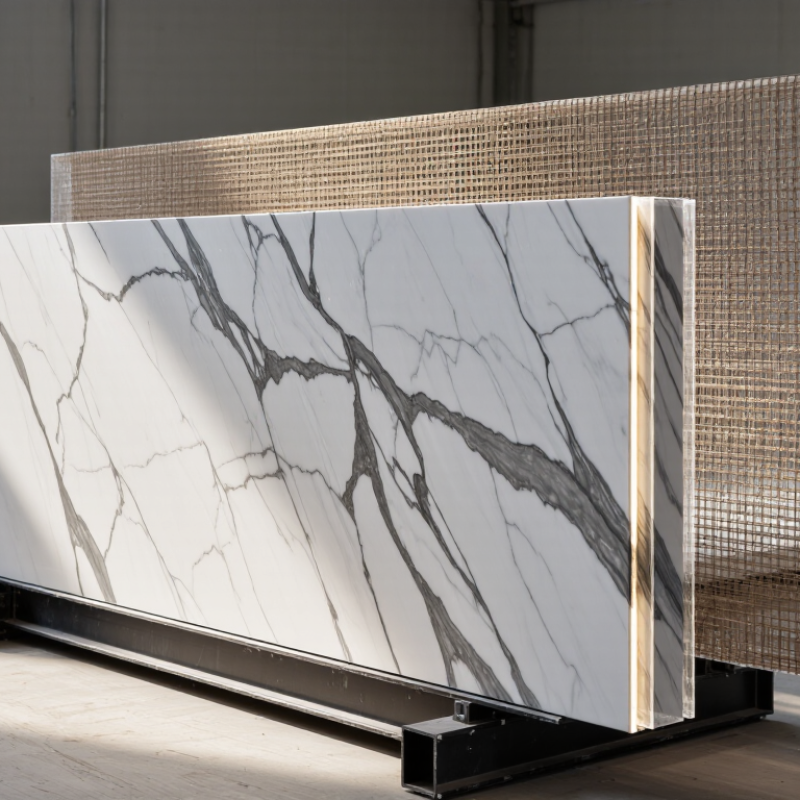
When a marble slab arrives with mesh backing, the material may look different from traditional stone. The woven layer usually sits behind the marble, bonded with resin or another adhesive. It is not decorative. The answer is practical.

Why is some marble reinforced with mesh backing? Natural marble can contain thin veins, tiny fissures, or fragile areas formed during geological pressure. A mesh layer helps hold weaker pieces together during cutting, polishing, transport, and installation. This support becomes especially useful for thin slabs, bookmatched panels, and stones with dramatic veining. Imagine lifting a large polished sheet across a workshop. Without reinforcement, stress can concentrate around one narrow crack.

Experienced fabricators often inspect the backing before cutting or bonding the slab. They check whether the mesh is firmly attached, evenly covered, and compatible with the planned adhesive. Some backing can affect edge finishing, repairs, or future removal. That detail is easy to overlook.

Not every reinforced slab has the same quality. Mesh type, resin coverage, marble thickness, and manufacturing standards all matter. A reliable evaluation should include the stone’s intended use, moisture exposure, support conditions, and installation method. A kitchen wall, bathroom floor, and exterior feature may require different decisions.

There is no universal answer. Some concerns remain.

This guide explains the purpose of mesh backing, its advantages, possible limitations, and inspection points. It also separates common assumptions from practical evidence, helping buyers, designers, and installers make more informed choices. Even professionals can miss hidden weaknesses beneath a beautiful surface.
How to Understand Why Marble Has Mesh Backing

Define Marble Mesh Backing Through 300 × 300 mm Mosaic Sheet Formats

A 300 × 300 mm marble mosaic sheet covers 0.09 square metres, or roughly 11.1 sheets per square metre before gaps and cutting waste. That simple format helps explain the mesh: small marble pieces need a temporary carrier to stay aligned during handling and installation. On site, the backing keeps the pattern intact as a setter lifts a sheet from the box and presses it into fresh mortar. Less juggling. Fewer shifting pieces.

Mesh does not make every mosaic equally strong. Backing material, adhesive coverage, stone thickness, and installation conditions all matter. ASTM C503/C503M, the industry specification for marble dimension stone, addresses stone quality and physical requirements; it does not establish a universal performance rating for mesh-backed mosaic sheets. Buyers should therefore check the sheet maker’s technical data and test the actual assembly when conditions are demanding. A mesh that feels secure in the hand can still be poorly bonded to the stone. That detail is easy to miss. A small sample board can reveal uneven faces, weak mesh adhesion, or mortar showing through pale marble, though testing one sheet is not a full installation trial.

Identify Fiberglass Mesh, Epoxy, and Cement-Based Backing Materials

Marble may arrive with a backing because thin or fragile pieces need support during cutting, transport, or installation. Turn a loose sample over and look closely. A regular woven grid usually indicates fiberglass mesh. The strands may be white or pale, and a clear or amber resin may hold them against the stone. Mesh can feel slightly textured, but its appearance varies beneath different finishes.

Epoxy is a resin, not the mesh itself. It may form a glossy, hard layer over the back, or bind mesh to the marble. A yellow tint can develop, though color alone does not identify the material. Don’t pry at an installed backing to test it; that can chip stone or loosen a repair. The surface may also hide more than one material.

Cement-based backing typically looks gray and granular, with a matte, gritty feel. It may appear as a thin coating or a thicker layer used to reinforce a panel. Unlike a neat woven grid, its texture is usually uneven. Still, appearance is not proof. Dust, old adhesive, and stone color can confuse the picture. A close photo and the supplier’s material specification are safer clues than scraping the underside. I’ve seen small samples look obvious, then differ from the full slab. That uncertainty matters when choosing an adhesive or planning a repair.

Explain How Mesh Reinforces Marble Alongside ASTM C880 Flexural Testing

Marble is a natural stone with veins, tiny fissures, and uneven mineral layers. A mesh backing can help hold a thin slab together during cutting, transport, and installation. It may reduce the chance of pieces separating if the stone cracks. It does not make every marble slab equally strong. Look closely.

ASTM C880 evaluates the flexural strength of dimension stone by bending prepared specimens under a controlled load. The result indicates how the stone resists bending; it is not a guarantee that a finished, mesh-backed tile will perform the same way. Test conditions, stone thickness, vein direction, and specimen preparation all matter. Mesh can affect how fragments stay together, but the stone itself still carries the bending stress. In practical terms, a backed sample may remain more intact after damage, while its marble can still fracture. That distinction is easy to overlook. For meaningful comparisons, ask whether the tested specimens included backing and whether their dimensions and orientation matched the intended use. Even then, a test result cannot capture every weakness in a particular slab. I would not treat mesh as a substitute for careful handling or suitable support.

Assess Installation Limits: 2–3 mm Joints and Full Adhesive Coverage

Mesh backing helps hold small marble pieces together, but it does not remove the need for careful setting. Check the sheet’s thickness and flexibility before installation. Some mesh-backed mosaics can compress unevenly, especially over dips in the substrate. For many installations, 2–3 mm joints create a neat layout, but follow the tile supplier’s guidance and keep spacing consistent. Dry-lay several sheets first. Look for repeating patterns and adjust sheet edges before adhesive is applied.

Full adhesive coverage matters. A notched trowel should leave even ridges, and pressing the sheet gently into the mortar should collapse them without forcing adhesive up through the joints. Lift a corner occasionally to check the back. You should see contact across the tile, not isolated stripes or bare patches. Mesh and resin can limit bonding, so confirm the setting material is suitable for the specific backing. This detail is easy to miss.

Tips

Use a flat beating block to level sheets without tapping individual stones. Clean squeezed-out adhesive before it hardens, using a tool that will not chip the marble. If joints vary slightly, pause and correct the alignment; hoping they will disappear later rarely works.

Compare Mesh-Backed and Solid Marble Using ASTM C1526 Performance Criteria

Mesh backing can help hold thin marble together during cutting, shipping, and installation. It is common on pieces with fragile veins or small fissures. The mesh may improve handling, but it does not turn weak stone into solid stone. Look closely at the slab edge: resin and fibers can conceal cracks that would otherwise be visible.

ASTM C1526 is a key limitation in this comparison. It covers serpentine dimension stone, not marble, so its acceptance criteria should not be treated as a marble rating. For marble, ASTM C503 is the more relevant specification. Compare documented properties such as absorption, density, and strength, and confirm that testing applies to the actual stone type. Backing is not a substitute for test data. Ask whether results describe the stone alone or a mesh-and-resin assembly; those are not interchangeable.

In practice, examine both backed and unbacked samples under consistent conditions. Check for loose fibers, resin buildup, open fissures, and edge movement. A backed sample may resist handling damage yet still perform poorly under bending or moisture exposure. That distinction is easy to miss. For a kitchen wall, the risk differs from a frequently wet shower or a floor carrying heavy loads. Specifications help, but installation conditions matter too. A small test panel can reveal issues that a polished sample hides.

How to Understand Why Marble Has Mesh Backing - Compare Mesh-Backed and Solid Marble Using ASTM C1526 Performance Criteria

Standards note: ASTM C1526 is a specification for serpentine dimension stone, not marble. For marble, ASTM C503 is the relevant dimension-stone specification. The test methods below help describe stone properties, but a mesh backing does not automatically establish compliance with any ASTM specification.

Comparison dimension Mesh-backed marble Solid, unbacked marble Relevant ASTM context
What the backing is A mesh layer, usually bonded to the back of the stone, that can help retain small pieces and support fragile or thin material during handling. Stone without an attached mesh layer; the stone itself provides the full section thickness. Neither C1526 nor C503 defines mesh backing as a separate marble performance grade.
Why mesh may be used May help stabilize naturally fissured, veined, thin, or breakage-prone pieces during fabrication, transport, and installation. May be suitable where the stone has adequate integrity and thickness for the intended fabrication and installation. Backing is a fabrication or handling feature, not a substitute for evaluating the stone's properties.
Water absorption and bulk density The mesh does not, by itself, show the marble's absorption or density. Test representative stone specimens, excluding backing effects where applicable. Can be assessed as stone using the applicable test procedure and specimen preparation. ASTM C97/C97M covers absorption and bulk specific gravity of dimension stone. ASTM C503 provides marble specification requirements.
Flexural strength A mesh may affect the behavior of a bonded stone-and-mesh assembly, but it does not establish the flexural strength of the marble alone. Stone flexural strength can be tested on specimens prepared in accordance with the specified method. ASTM C880/C880M is the test method for flexural strength of dimension stone. Results depend on specimen orientation and test configuration.
Compressive strength Backing should not be assumed to increase the marble's compressive strength; the stone and the bonded assembly are different test subjects. The stone's compressive strength can be measured on appropriately prepared stone specimens. ASTM C170/C170M covers compressive strength of dimension stone.
Abrasion resistance The mesh is on the back and does not indicate how resistant the exposed marble surface is to wear. Surface wear performance depends on the marble and finish, and should be assessed for the intended use. ASTM C1353/C1353M is a test method for abrasion resistance of dimension stone subject to foot traffic.
Bond and assembly performance Performance depends on mesh type, adhesive, coverage, curing, stone condition, and exposure. Ask for product-specific evidence if the bond is important to the application. There is no mesh-to-stone bond to assess; installation depends on the stone, setting system, substrate, and detailing. Stone test results alone do not qualify an adhesive or mesh bond. Confirm that any test report identifies whether it tested stone or the complete assembly.
How to compare test results Request results for the marble itself and, when relevant, separate testing of the mesh-backed assembly. Compare results from the same stone type, orientation, thickness, finish, and test method. ASTM methods specify how to test; acceptance limits come from the applicable product specification, project documents, or design requirements. Do not infer a pass value from C1526 for marble.

Practical takeaway: Mesh backing can help with handling fragile marble, but it is not proof of higher stone strength or ASTM compliance. Verify the marble specification, relevant test reports, and suitability of the complete installation system for the intended application.

FAQS

How does mesh backing help marble?

Mesh can hold small marble fragments together during cutting, transport, and installation. It may reduce separation after cracking. The stone can still fracture.

Does mesh make every marble slab stronger?

No. Marble still contains veins, fissures, and uneven mineral layers. Mesh supports fragments, but it does not remove natural weaknesses.

What does ASTM C880 flexural testing measure?

ASTM C880 measures how prepared stone specimens resist bending under controlled loading. It evaluates flexural strength. It is not a finished installation guarantee.

Can a mesh-backed test result predict tile performance?

Only partly. Thickness, vein direction, specimen size, backing, and preparation can change the result. I would check whether testing matched the intended installation.

What joint width is commonly used for marble sheets?

Many installations use 2–3 mm joints. Keep spacing consistent. Dry-lay several sheets and adjust edges before applying adhesive.

How can installers check adhesive coverage?

Press the sheet gently into fresh mortar. Lift one corner occasionally. The back should show broad contact, not bare patches or separate stripes.

Can mesh or resin affect bonding?

Yes. Mesh and resin may limit adhesive contact. Confirm that the setting material suits the specific backing before installation.

How should marble sheets be leveled?

Use a flat beating block instead of tapping individual stones. Check the surface carefully. Small alignment errors may remain visible.

What should be done when adhesive squeezes into the joints?

Remove excess adhesive before it hardens. Use a tool that will not chip the marble. Waiting usually makes cleanup harder.

What installation risk is easy to overlook?

Uneven substrates can compress some mesh-backed mosaics unevenly. Full adhesive coverage matters, but it cannot correct every surface problem. I may still miss a weak stone.

Conclusion

Why is some marble reinforced with mesh backing? Marble mosaic sheets, often supplied in 300 × 300 mm formats, may have mesh attached to help hold small pieces together during handling and installation. The backing can consist of fiberglass mesh secured with epoxy or a cement-based adhesive. It can make thin or fragmented pieces easier to manage, but it does not change the stone’s natural properties or eliminate the need for careful support.

Mesh can help distribute handling stresses, while flexural testing such as ASTM C880 evaluates the stone’s resistance to bending. For installation, use full adhesive coverage and maintain consistent joints, typically around 2–3 mm, to support the marble evenly. Mesh-backed and solid marble should be compared by considering their construction and relevant performance criteria, including ASTM C1526. Neither backing nor a test designation alone guarantees suitability; selection should reflect the stone, application, and installation conditions.

Amelia

Amelia

Amelia is a seasoned marketing professional with a wealth of expertise in our company’s core offerings. With an unwavering passion for driving growth and innovation, she plays a pivotal role in shaping our marketing strategies and enhancing brand visibility. A key aspect of her responsibilities......